Fall Protection
Certificate & Training

Required by Federal Law under OSHA 29 CFR 1926 /1910

Get Started

Select the option that best applies:

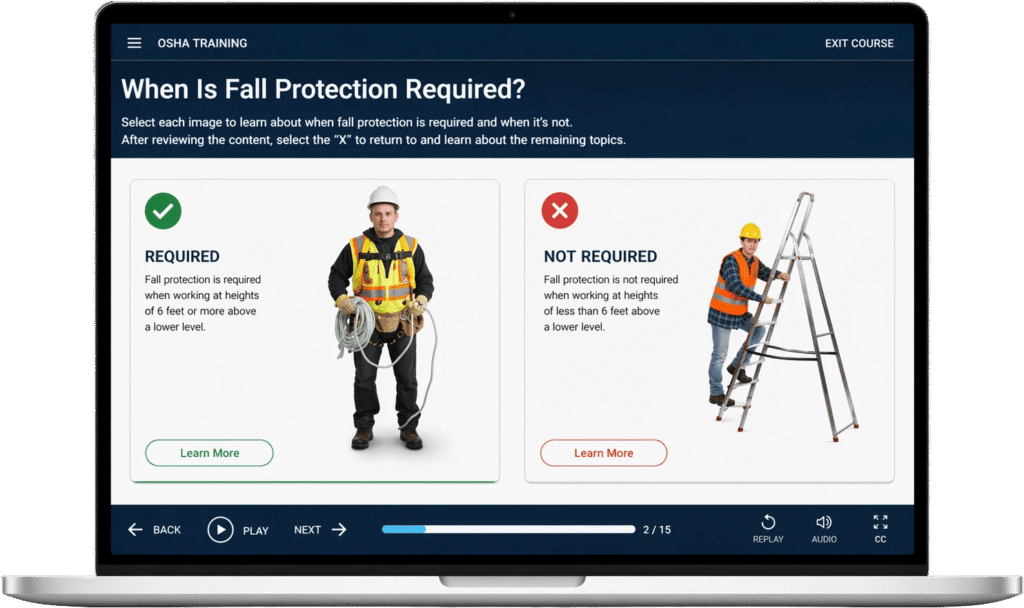
Falls are the leading cause of construction accidents and traumatic occupational death, according to the U.S. Department of Labor. As a result, workers are required to complete fall protection training when working at a height of 6 feet or higher, or when a worker might be exposed to fall hazards. This 2.5-hour online course satisfies the training and retraining outlined in the OSHA 29 CFR 1926 Subpart M Fall Protection Standard, including Residential Construction Fall Protection.

This course is offered by 360training. National OSHA Foundation is owned and operated by 360training.

Available on any device.
24/7.

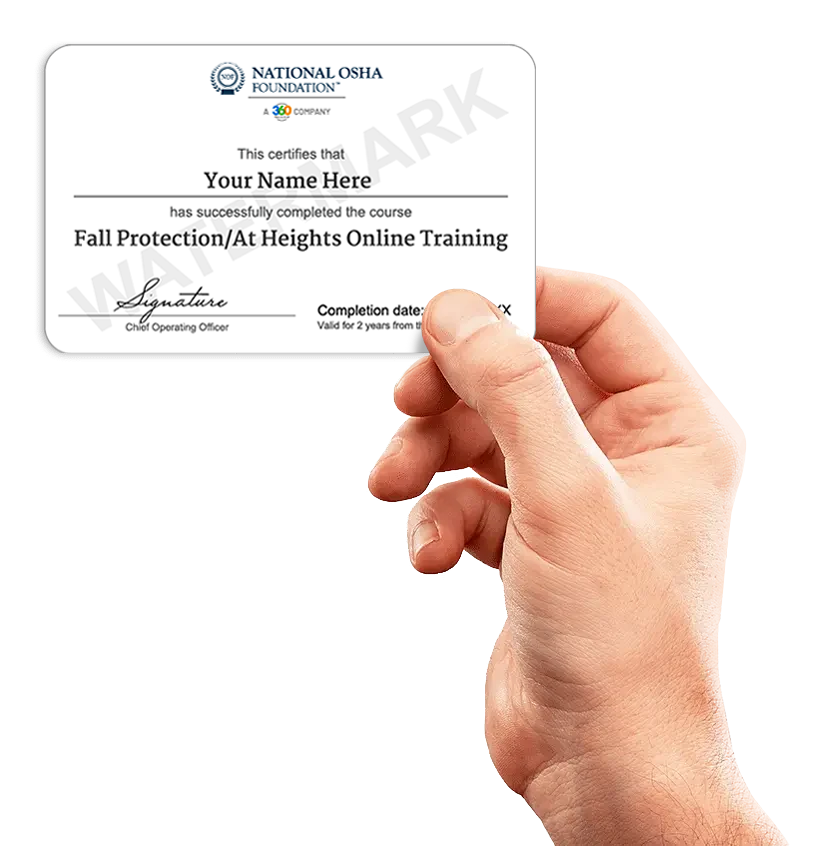
Work anytime, anywhere, at your own pace, and when you feel comfortable with the material, you can then take the final exam. Includes three (3) exam attempts. After passing the final exam, you will be able to download your certificate of completion.

Stay OSHA-Aligned

The fall protection training program has been developed to satisfy all requirements nationwide. We help you avoid penalties & injuries by ensuring the highest quality training material available.

Fall Protection certification card

Bundle With 2026Bundle With 2026 MEWP Training

You can also get OSHA Certifications for scissor lifts and boom lifts. Easily bundle courses.

Trusted and Accepted

Join the thousands of organizations both small and large who have trained workers.

MicrosoftTeams-image (10)
My supervisor said I needed to come and get my fall protection certification. I was nervous because I don’t like tests, but it was simple and straight forward. Passed on my first try and didn’t take long at all.

Devon D.

Scissor Lift Operator

toyota-logo-1.jpg

Toyota’s number one priority is safety. Managing a manufacturing campus of 10,000 employees, OSHA compliance is something we take very seriously. Fall protection safety is paramount, therefore we mandate our employees be competent and certified.

Kevin E.

Safety Manager - Toyota

Getting Started is Simple

We’ve made it easy to meet the OSHA-recommended training requirements

1

Enroll your employees or yourself in the training by clicking here

2

Complete the 2.5-hour online curriculum and test

3

Automatically print certificate of completion & onsite evaluation checklist

FAQ's

It outlines a variety of different methods to safeguard against falling at height, how to use fall protection equipment, as well as providing guidance on how safety managers can ensure the health and safety of construction workers. We’ll discuss the areas of a job site that require fall protection and the types of protection that might be used, including guardrails, safety net systems, and personal fall arrest systems.  We’ll also discuss how to inspect fall protection equipment. 

The average time for completion is 2.5 hours.

To start the process to become a forklift operator, you must:

  • Be a U.S. Citizen

The requirements to complete certification include:

  • Completing a formal instructional and educational training class that meets OSHA 1910.178 standards
  • Completing a formal evaluation (online or in a classroom)
  • Presenting the written certificate of completion to a future or current employer for sign-off and approval

This course satisfies the training recommendations identified by the Occupational Safety and Health Administration, and provides the written documentation needed to provide to an employer.

Yes, it is the law. Even without injury or death, OSHA can impose a $7,000.00 fine for each untrained operator.

The reason this is mandatory is to help reduce the number of injuries due to unsafe operations in the workplace.

Yes, you can complete the training at your own pace. Once you start the course, you have 90 days to complete the training and final exam. Furthermore, you have three (3) attempts to pass the final exam.

There are 4 classes of fall protection training, including awareness, authorized-user, competent person, and qualified person training.

All workers, supervisors, and managers who work near or supervise any area that requires fall protection: leading-edge work, hoist areas, formwork, rebar, walkways, excavations, roofing activities, and wall openings. In addition, fall protection training is also required for any employee who operates a powered industrial truck, including aerial and scissor lifts. Workers who inspect or assess job sites before the start of work are exempt from OSHA’s fall protection standards

Industry leaders recommend that you refresh training every 2 years

For more information, contact your local or Regional OSHA office (listed in the telephone directory under United States Government – Department of Labor – Occupational Safety and Health Administration). OSHA also has a Home Page on the Internet.